

Which hinges hold a heavy steel gate without sagging
2026-11-09
Why do hinges decide whether a steel gate sags?

Hinges carry the whole weight of the leaf and the turning force of every swing, so a weak or badly placed hinge is the first thing to fail on a heavy steel gate. The frame can be perfectly welded and the post perfectly set, and the leaf will still drop at the latch end within a year if the hinges were sized for a lighter gate. In Georgetown, where a leaf may swing thousands of times through summer heat and winter cold snaps, the hinge is the moving part that takes the punishment.
What are the main hinge types used on steel gates?
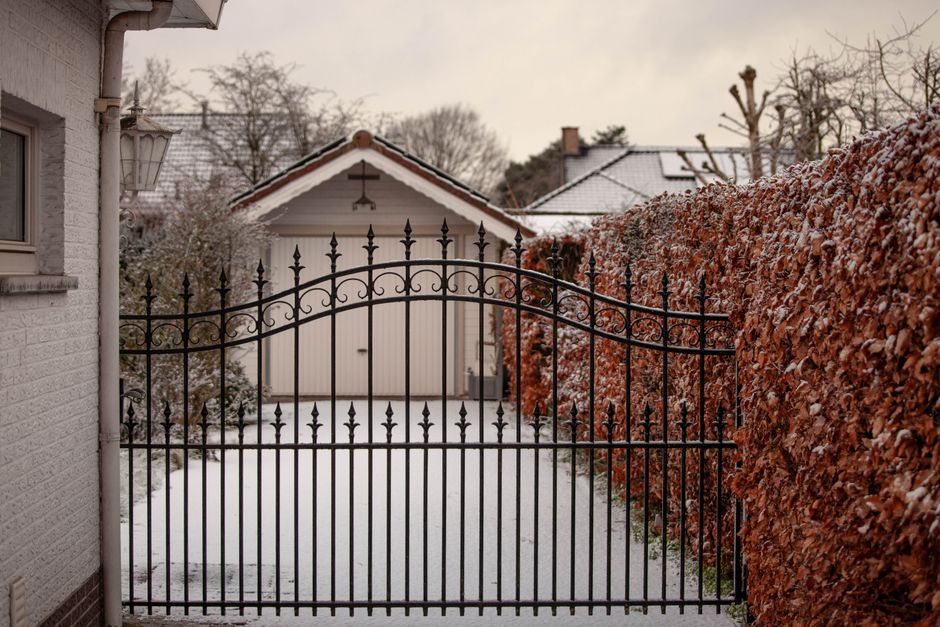
Three families cover most steel gate work: weld on barrel hinges, bolt on adjustable hinges, and heavy duty ball bearing hinges. A barrel hinge is a pin inside a sleeve, welded to the post and the frame. A bolt on hinge uses a threaded eye or a strap so the position can be changed after hanging. A ball bearing hinge carries the weight on a thrust bearing between the knuckles, which keeps the leaf turning easily even when it is heavy. Each type has a weight range where it works well and a range where it does not.
How do barrel hinges behave on a long driveway leaf?
Barrel hinges are simple and strong, but they wear where the pin rides inside the sleeve. On a light pedestrian gate that wear takes years to matter. On a driveway leaf that weighs a few hundred pounds, the sleeve ovals out, the leaf drops a little, and the latch begins to miss its keeper. Grease helps, and a greased fitting on the hinge lets the owner keep the pin lubricated. A washer or a thrust cap at the bottom of the knuckle keeps the leaf from grinding straight down onto the lower hinge.
When is a ball bearing hinge worth the trouble?
A ball bearing hinge is worth using whenever the leaf is heavy, long or fitted with an operator arm. The bearing takes the vertical load without friction, so the leaf swings freely and the operator does not strain against drag. Heavy solid panel gates, tall privacy leaves and gates with dense ornamental infill all fall into that group. The extra cost of the hardware is small compared with the cost of pulling a leaf, replacing a worn sleeve and re-welding a hinge stile.
How big should the hinge pin be?
The pin diameter should match the weight and the leaf width, with five eighths of an inch a common minimum for a driveway leaf and three quarters of an inch or more for a wide one. A pin that is too thin bends slightly under load, and that bend turns into slop. Hinge knuckles also need enough length to spread the load into the frame. A short knuckle on a heavy leaf concentrates the stress at one spot on the stile, where a crack will start along the weld.
Where do hinges go on the leaf?
Hinges go as far apart as the leaf height allows, usually a few inches in from the top and bottom rails, because the wider the spread the less force each hinge carries. A tall leaf with hinges close together acts like a lever, and the top hinge pulls out of the post while the bottom hinge pushes in. On a leaf taller than six feet, a third hinge at the middle rail helps keep a long vertical stile straight. The hinges also line up on a single vertical axis, since an axis that leans even slightly makes the leaf swing open or closed by itself.
Why does the hinge axis need to be plumb?
The hinge axis must be plumb because gravity pulls on any leaf that swings around a tilted line. A leaf hung on a post that leans toward the drive swings shut on its own, and a leaf on a post that leans away swings open. Some crews tilt the axis on purpose by a hair to help a gate close, but that setting needs a careful hand. Most of the time a plumb pair of hinges, checked with a level on both faces of the post, gives the calm, even swing that people expect.
How does the post change the hinge choice?
The post sets the limit on how much the hinge can hold, because a hinge is only as secure as the steel or masonry behind it. A square steel post with a thick wall takes a welded hinge well. A hollow brick column cannot carry a heavy leaf at all unless a steel post is cast inside it. In clay soil around Georgetown that moves with the weather, a post that shifts even a quarter inch at the top changes the hinge angle at the bottom. That is why the footing and the hinge are planned together.
What does adjustability add?
An adjustable hinge lets a crew fix a leaf that has dropped or twisted without cutting any steel. A threaded eye lets the leaf be raised or lowered by turning a nut, and a slotted strap lets it move toward or away from the post. Over the first season a new gate settles, and a few turns on the adjusters bring the latch back to the center of the keeper. A fixed weld on hinge leaves no such room, so any change after the first year means grinding and re-welding.
What are the early signs of a failing hinge?
The early signs are a squeak, a leaf that drags at the bottom corner, a latch that no longer lines up, and a dark streak of rust dust under the knuckle. Each sign means the pin or the sleeve is wearing and the leaf is sinking a little with each swing. Catching it early costs a grease fitting and a washer. Waiting until the leaf scrapes the driveway means a bent hinge stile and often a new pin and sleeve on both hinges.
How does finish affect a hinge?
A hinge needs a finish that lets it move, so the knuckle surfaces stay bare and greased while the rest of the hardware is galvanized or coated. Paint that runs into the knuckle seizes the pin in the first humid week. Powder coat on the weld on parts is fine, but the bearing faces are masked before the gate goes into the oven. Stainless pins in a galvanized sleeve resist the rust that locks a plain steel pin in place during a damp spring along the San Gabriel River.
How is a sagging leaf corrected?
A sagging leaf is corrected by finding which part has moved: the post, the hinge or the frame. The crew props the leaf at its correct height, checks the post with a level, inspects the sleeve and pin for wear, and looks for a crack in the stile weld. If the post leans, the footing is the problem and no hinge adjustment will hold. If the sleeve is worn, a new pin and bushing restore the swing. If the frame has racked, a diagonal brace is added and the corners are re-welded square.
What should be checked every year?
- Grease each hinge fitting and wipe the old grease from the knuckle.
- Check the leaf height at the latch end against a mark made when the gate was new.
- Look at the hinge welds for hairline cracks and rust staining.
- Plumb the post and compare it with last year.
- Open the gate by hand and listen for a grind or a catch.
A short yearly check takes about ten minutes and catches almost every hinge problem before it turns into a repair.
How do hinges and a gate operator work together?
An operator arm pushes the leaf from the hinge side, so the hinge takes extra side force on top of the weight. A heavy ball bearing hinge handles that force with little drag, while a worn barrel hinge makes the motor work harder and trip its limit. Crews that plan an operator from the start choose the hinge, the post size and the arm mounting together, which saves a retrofit later. Around Sun City Texas, where many gates are automatic from day one, that planning shows in how quietly the leaf moves.
What is the simple way to choose?
Pick the hinge by the weight and width of the leaf, then size the pin and post to match. A light pedestrian gate does fine on barrel hinges. A heavy driveway leaf wants ball bearing hinges, a thick pin, wide spacing and a post set deep below the clay. Spend the effort on the hinges early, because they are the one part that cannot be hidden when it fails.